

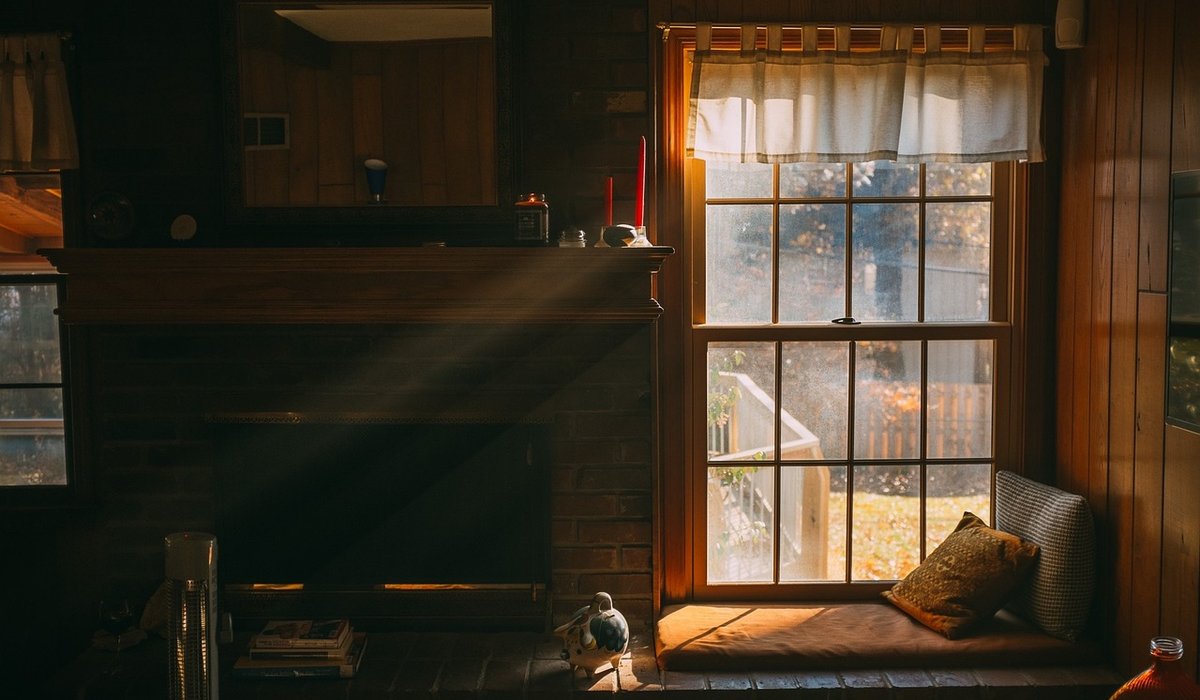
In a barn conversion or a cottage with exposed beams, a single pendant hanging from the centre of the room rarely works. The beams cast hard shadows, the vaulted ceiling sends light in awkward directions, and a bright bulb at eye level creates glare. Instead of fighting the architecture, you need to work with it. Layered lighting — using wall lights, floor lamps and discreet directional fixtures — lets you reveal the texture of old timber without turning your living room into an airport runway. The goal is to light the room in horizontal bands, so your eye travels up the walls and across the beams rather than squinting into a bare bulb.
Wall lights are your first line of defence. Mount them on the beams themselves, or on the wall between beams, and aim them upwards. A pair of up-and-down wall lights placed halfway up a vaulted wall will graze the underside of the roof and pick out the grain of every rafter. Choose fixtures with a warm white LED, around 2700K, and a beam angle of 30 to 45 degrees. You want a soft wash, not a spotlight. If your beams are dark, use a slightly higher output — around 400 lumens per fitting — but keep the colour temperature warm to avoid a clinical feel. For a more dramatic effect, place a single uplighter on the floor at the base of a vaulted wall; it will throw a broad triangle of light that emphasises the height of the room without any glare at eye level.
High ceilings can make a room feel cavernous at night. Floor lamps and table lamps fill that gap. Place a floor lamp with an adjustable head next to your favourite armchair for reading, and use a table lamp on a sideboard or windowsill to create a warm pool of light. Look for rustic materials: turned wood, aged brass, wrought iron, linen or hessian shades. A lamp with a dimmable bulb lets you lower the light after dinner. Avoid placing lamps directly under a beam, where they will throw a hard edge; instead, position them slightly to one side so the light spills across the wall. Two or three lamps at different heights will do more for a barn conversion than one bright ceiling fixture ever could.
Sometimes you need light exactly where you want it — on a kitchen worktop, a piece of art, or a staircase. This is where discreet directional fixtures earn their keep. Small surface-mounted spotlights or track lights can be fixed to beams without drilling into ancient timber if you use clamps or straps. Aim them at walls or up at the ceiling, never directly into the room. A narrow beam angle of 24 degrees is good for highlighting a single beam or a stone wall; a wider 36-degree beam works for washing a larger area. Keep them on a separate switch so you can turn them off when you want a softer mood. For low beams, consider a slim linear LED fitted along the top edge, pointing upwards — it disappears during the day and adds a gentle glow at night.
The secret to successful lighting in a beamed or vaulted room is control. Put your wall lights, floor lamps and directional spots on separate circuits — or at least separate dimmer channels. That way you can create three or four scenes: bright for cleaning, medium for entertaining, low for a cosy evening. A multi-gang dimmer switch is a practical investment. If you are renovating, run extra cable now; it is far easier than chasing walls later. And always choose dimmable LED bulbs that are compatible with your dimmer, or you will get flicker and buzz. Test a few bulbs before you commit to a whole set, as some cheap LEDs behave badly at low levels.
Old timber is beautiful but demanding. Uplighting will highlight every cobweb, so keep a long-handled duster handy. High vaulted ceilings also mean changing bulbs is a chore — choose long-life LEDs rated for 25,000 hours or more. Avoid cool white or daylight bulbs; they make oak look grey and kill the rustic warmth. If your ceiling is very high, consider a winch or a telescopic pole for maintenance. Finally, check that any fixture near a roof space is suitable for the environment — barn conversions can be dusty, and some spots need an IP rating. With a little planning, your lighting will flatter the beams rather than fight them, and you will enjoy the architecture long after the sun goes down.

The Gildedbarn Written for people who value the details, and want honest guidance they can trust.

The Gildedbarn An honest, everyday look at the things that make life a little better — with advice you can actually use.

Dark barn interiors can be brightened with rooflights, pale surfaces and carefully placed mirrors, while retaining the building's comforting sense of shelter.

Comments
ALina Kelian
19th May 2018 ReplyThe Gildedbarn An honest, everyday look at the things that make life a little better — with advice you can actually use. ullamco laboris nisi ut aliquip ex ea commodo consequat.
Rlex Kelian
19th May 2018 ReplyThe Gildedbarn We spend our time finding what works so you don't have to, and sharing exactly what made the difference. ullamco laboris nisi ut aliquip commodo.
Roboto Alex
21th May 2018 ReplyThe Gildedbarn An honest, everyday look at the things that make life a little better — with advice you can actually use. ullamco laboris nisi ut aliquip ex ea commodo consequat.